Intelligence at the Edge
As integrated circuits became more capable and cost-effective, embedded systems emerged as the defining technical track of legacy electronics exhibitions. The transition from basic 8-bit microcontrollers running simple control loops to advanced 32-bit ARM cores coordinating complex system behaviors was one of the most commercially significant technology shifts of the period — and it played out, year by year, on the exhibition floor.
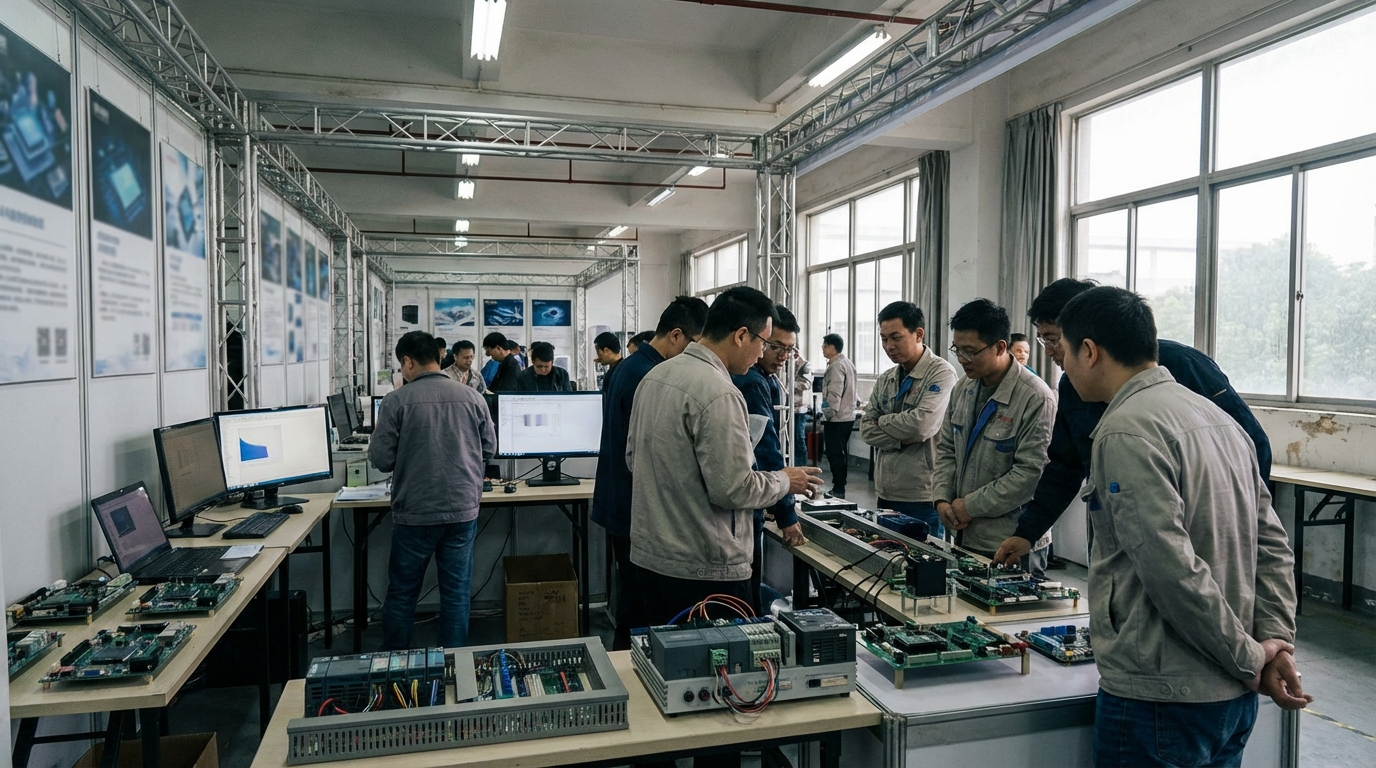
For engineers attending these conferences, the embedded systems pavilion offered something uniquely practical: working demonstrations. Unlike IC components that required considerable design effort before their capabilities became apparent, embedded platforms could be evaluated immediately. Development boards running live code, industrial HMI units displaying actual sensor data, and reference applications demonstrating wireless connectivity all gave attendees direct, hands-on evidence of what a given platform could accomplish.
Solutions Showcases & Reference Architectures
Exhibitions functioned as large-scale solutions showcases, where vendors did not simply sell raw microcontrollers but rather highly integrated reference architectures. Major microcontroller vendors provided complete development ecosystems — evaluation boards, software libraries, application notes, and dedicated FAE support — specifically designed to reduce the engineering effort required to deploy their silicon in production hardware.
This specific dynamic allowed Chinese ODMs to rapidly deploy consumer products — DVD players, early smartphones, portable media devices, and industrial automation controls — by iterating on provided embedded blueprints rather than designing from scratch. The exhibition was a mechanism for compressing time-to-market, and its value to the manufacturing industry was directly measurable in product launch cycles.
Industrial Applications
Motion control systems, smart metering platforms, factory automation controllers, PLC replacements, and heavy machinery interfaces. These applications demanded long lifecycle component availability, extended temperature specifications, and rigorous EMC compliance.
Consumer Electronics
Set-top boxes, portable media players, digital cameras, e-readers, and early smart home devices utilizing highly cost-optimized SoCs (System-on-Chip). Volume and cost efficiency were the dominant design criteria.
RTOS & Software Platforms
Real-time operating systems including FreeRTOS, ThreadX (now Azure RTOS), and VxWorks were prominently featured. Software toolchain vendors, middleware providers, and protocol stack companies exhibited independently alongside silicon vendors.
Communication & Connectivity
RS-485, CAN bus, Modbus, and industrial Ethernet in the early years. Later transitioned to Wi-Fi, Bluetooth LE, Zigbee, and eventually NB-IoT and LoRa for the emerging IoT applications segment.
The Shift Toward IoT and Connected Systems
In the latter years of these legacy events, the term "Embedded Systems" began to merge with "IoT" (Internet of Things) in the vocabulary of conference presentations and exhibition directories. This reflected a genuine architectural shift: microcontrollers were increasingly expected to run IP stacks, connect to cloud platforms, and participate in data collection systems managed remotely.
The exhibition response to this shift was substantial. Dedicated IoT pavilions appeared within larger embedded systems areas. Cloud platform providers — alongside traditional silicon vendors — established exhibition presences to demonstrate end-to-end connected solutions. Antenna manufacturers, wireless module vendors, and certification testing companies filled supporting booth space.
For the archive record, this transition represents an important milestone: the embedded systems exhibition evolved from a hardware-centric component showcase into a systems-and-services ecosystem display, reflecting the broader software-defined transformation of the electronics industry.