
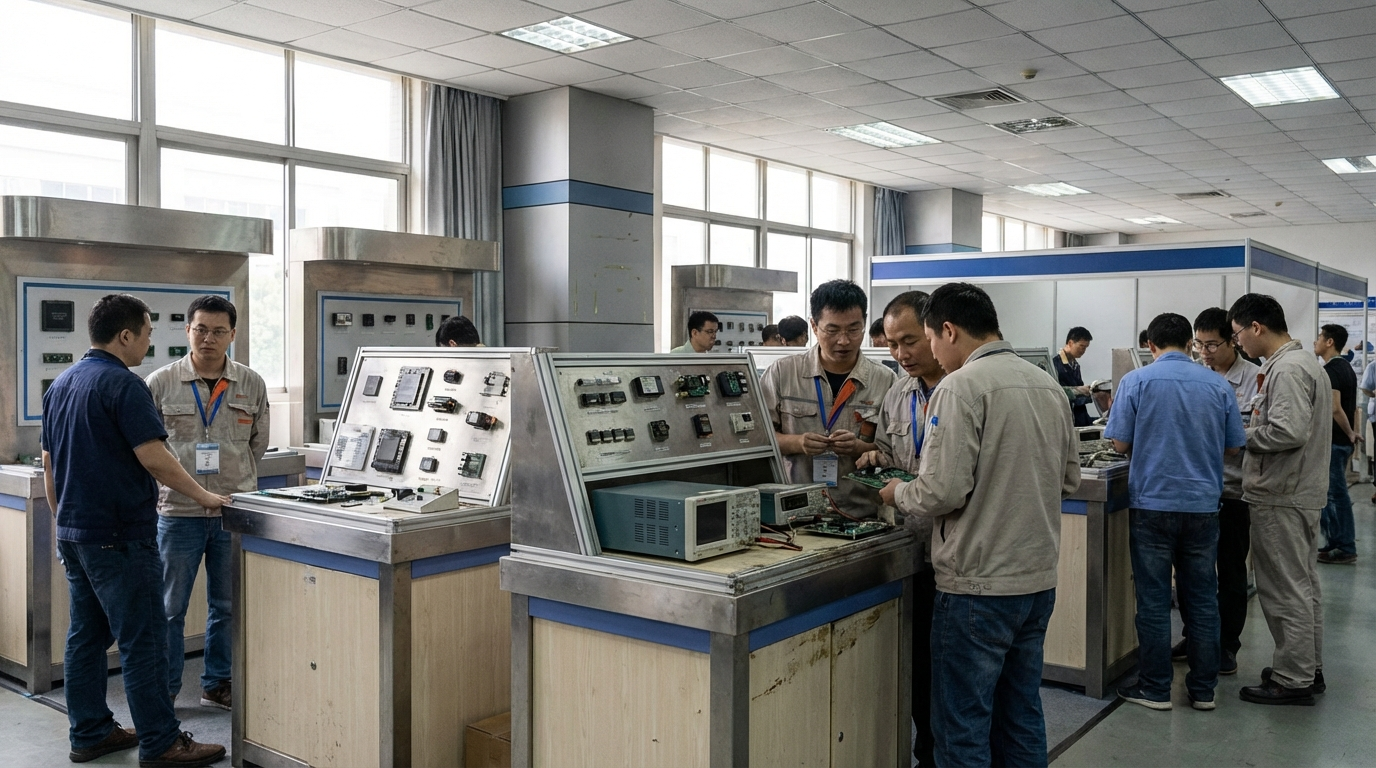
The Backbone of the Electronics Boom
The history of IIC Expo directly mirrors the aggressive expansion of the global semiconductor supply chain into China's manufacturing centers. From the early days when foreign chip companies established their first mainland distribution relationships to the later era of domestic IC design and foundry competition, each stage of this evolution was documented on the exhibition floor.
The semiconductor pavilion was traditionally the anchor of any legacy IIC Expo show. It served as the singular physical point where silicon vendors — representing the start of the supply chain — directly interfaced with board-level engineers representing the end-product. The commercial density of this environment, repeated annually across multiple cities, accelerated China's integration into the global electronics value chain at a pace that would have been impossible through remote commercial channels alone.
Component Supply Chain & Distributor Networks
Procurement crises, global wafer shortages, and the shift to localized sourcing defined many conference agendas. Distributors — both authorized channel partners and independent brokers — used exhibition networks to build reliable supply channels for MCUs, analog ICs, power management units, and the passive components feeding Southern China's massive consumer electronics manufacturing operations.
The authorized distributor ecosystem that formed around these exhibitions was structurally important. Companies like Arrow, Avnet, WPG, and Uniquest established regional presences specifically to serve the engineering buyer communities that gathered at these events. The trust relationships built on the exhibition floor translated directly into the multi-year distribution agreements that stabilized China's component supply during volatile market periods.
Packaging & Testing (OSAT)
A major historical focus of these exhibitions was Outsourced Semiconductor Assembly and Test (OSAT) services. As production volumes scaled, China moved progressively from basic assembly of through-hole components to advanced surface-mount technology (SMT) and eventually to complex system-in-package (SiP) solutions.
OSAT providers — including major Chinese firms that grew substantially during this period — exhibited alongside foundry companies and IC design houses to present integrated packaging solutions. This reflected the increasing sophistication of the domestic semiconductor supply chain and its capacity to serve not only volume consumer electronics production but also higher-reliability industrial and automotive applications.
Power Management & Analog IC
Power management ICs constituted one of the consistently highest-volume product segments across all years of the exhibition. The combination of mobile device proliferation, the transition to LED lighting, and the emergence of battery-powered industrial equipment created sustained demand for DC-DC converters, LDO regulators, battery management ICs, and motor driver solutions.
International analog semiconductor companies competed intensely on the exhibition floor to position their power management portfolios with Chinese OEM design teams. The reference designs distributed at these booths frequently became the standard architecture adopted across thousands of derivative products manufactured in Southern China.
The Transition to Domestic IC Development
In the later years of these legacy exhibitions, the competitive landscape shifted noticeably. China-based fabless IC companies began appearing on the exhibition floor alongside established international brands, presenting competitive alternatives in power management, MCU, wireless connectivity, and sensor IC categories. This transition from a primarily import-dependent supply chain toward domestic semiconductor development was one of the defining industrial narratives of the period — and the exhibition floor documented its progress in real time.